Kobe Food Guide: What to Eat Beyond Kobe Beef
Key takeaways
- Kobe offers world-famous Wagyu alongside unique local comfort foods like soba-meshi and Akashiyaki.
- The city's historic port introduced rich bakery, Western confectionery (yogashi), and Chinese culinary traditions.
- Ordering beef requires choosing cuts and grades; budget lunch sets provide a more affordable introduction.
Kobe food is defined by world-renowned marbled wagyu beef alongside a vibrant harbour heritage of casual street dishes, European-style bakeries, and sake brewing. While sampling authentic Kobe beef ranks as a premier dining experience for visitors, the city's coastal geography and historic status as an international treaty port have created a diverse culinary scene that extends far beyond high-end steak.
First-time visitors arriving from Osaka (around 20 to 30 minutes via the JR Special Rapid Service) or Kyoto (roughly 50 minutes) will find an accessible, compact food culture. Understanding how local specialties are cooked, seasoned, and ordered ensures you make the most of your time in Hyogo Prefecture's capital.
What Defines Kobe Food Culture?
Kobe was among the first Japanese ports opened to foreign trade in 1868. This international exposure introduced Western butcher techniques, bread-making, and European dessert craft decades before they spread across the rest of Japan.
At the same time, local dockworkers and factory districts cultivated fast, filling comfort foods cooked on flat iron griddles (teppan). Fresh catches from the Seto Inland Sea and pure mountain water from the Rokko range also supported ancient industries like sake brewing in the Nada district. Today, dining in Kobe ranges from luxury teppanyaki counters to bustling arcade stalls.
For broader background on traditional production methods across Japan's agricultural sectors, refer to the Ministry of Agriculture, Forestry and Fisheries.
The Signature Dish: Kobe Beef (神戸ビーフ)
Kobe beef comes exclusively from Tajima-gyu cattle (Tajima-ushi), a pure strain of Japanese Black cattle raised in Hyogo Prefecture under strict lineage rules. The meat is famous for shimofuri, a fine, web-like pattern of intramuscular fat that melts at human body temperature.
How Kobe Beef is Graded
When reviewing a menu, you will encounter classification letters and numbers:
- Yield Grade (A to C): "A" indicates the highest proportion of usable meat from the cattle.
- Quality Grade (1 to 5): Based on marbling, meat colour, firmness, and fat lustre, with 5 being the highest.
- BMS (Beef Marbling Score): Ranging from 1 to 12, true Kobe beef must score a BMS of 6 or higher, among other rigorous standard thresholds.
Popular Ways to Eat It
- Teppanyaki (鉄板焼き): Sliced thick and seared on a flat iron griddle directly in front of diners. The chef seasons it lightly with sea salt, freshly cracked pepper, fried garlic chips, and freshly grated wasabi to let the natural sweetness of the fat dominate.
- Sukiyaki (すき焼き): Thinly sliced beef simmered in a sweet soy, mirin, and sugar broth alongside scallions, tofu, and mushrooms, dipped in raw beaten egg before eating.
- Shabu-Shabu (しゃぶしゃぶ): Paper-thin ribbons swirled briefly in a boiling kelp broth, then coated in sesame sauce (gomadare) or citrus soy (ponzu).
Practical Tips for Ordering Beef
- Lunch vs. Dinner: Teppanyaki dinners frequently run from 10,000 yen to over 30,000 yen per person. Lunch courses featuring identical quality cuts often cost between 4,000 yen and 8,000 yen.
- Lean vs. Marbled: If high-fat content feels overwhelming, choose lean cuts (akami, 赤身) such as round or sirloin instead of ribeye (rosu, ロース).
- Allergen Alert: Dipping sauces often contain soy, wheat (gluten), and sesame. Raw egg is standard for sukiyaki; inform staff if you cannot consume uncooked eggs.
We are working to carry Japanese craft and everyday culture beyond Japan, by building Japan Towns with local partners.
Read the Japan Town plan →Casual Griddle Classics: Soba-meshi (そばめし)
Soba-meshi is a quintessential Kobe street food invented in the working-class Nagata ward (長田).
What It Is
Soba-meshi combines cold cooked white rice and Chinese-style ramen noodles (yakisoba). The cook places both on a hot griddle, finely chops the noodles into grain-sized pieces using heavy metal spatulas (kote), and fries everything together with cabbage and suji-kon—beef tendon simmered with sweet konnyaku jelly. The dish is seasoned with sweet-savoury Worcestershire-style sauce and topped with dried green seaweed (aonori) and pickled red ginger (beni shoga).
How to Order and Eat Soba-meshi
- Walk into a casual okonomiyaki or griddle parlour. These shops are concentrated near Shin-Nagata Station (新長田駅) and Sannomiya Station (三宮駅).
- Take a seat at the counter to watch the chef chop the noodles, or at a griddle table.
- Order the standard suji-kon soba-meshi (すじ肉そばめし).
- Use small metal spatulas or standard chopsticks to eat directly from the griddle to keep the rice hot and slightly crisped at the bottom.
- Soba-meshi typically costs between 700 yen and 1,200 yen per serving.
Akashiyaki (明石焼き / 玉子焼)
Although originating in neighbouring Akashi, Akashiyaki is a beloved staple across Kobe's coastal menus.
How It Differs from Takoyaki
While standard Osaka takoyaki relies on a batter of wheat flour, thick sauce, and mayonnaise, Akashiyaki features:
- A batter made with a high volume of egg and a special starch called jin-ko, creating an exceptionally soft, pillowy texture.
- A tender octopus piece encased inside.
- No thick brown sauce on top.
How to Eat It
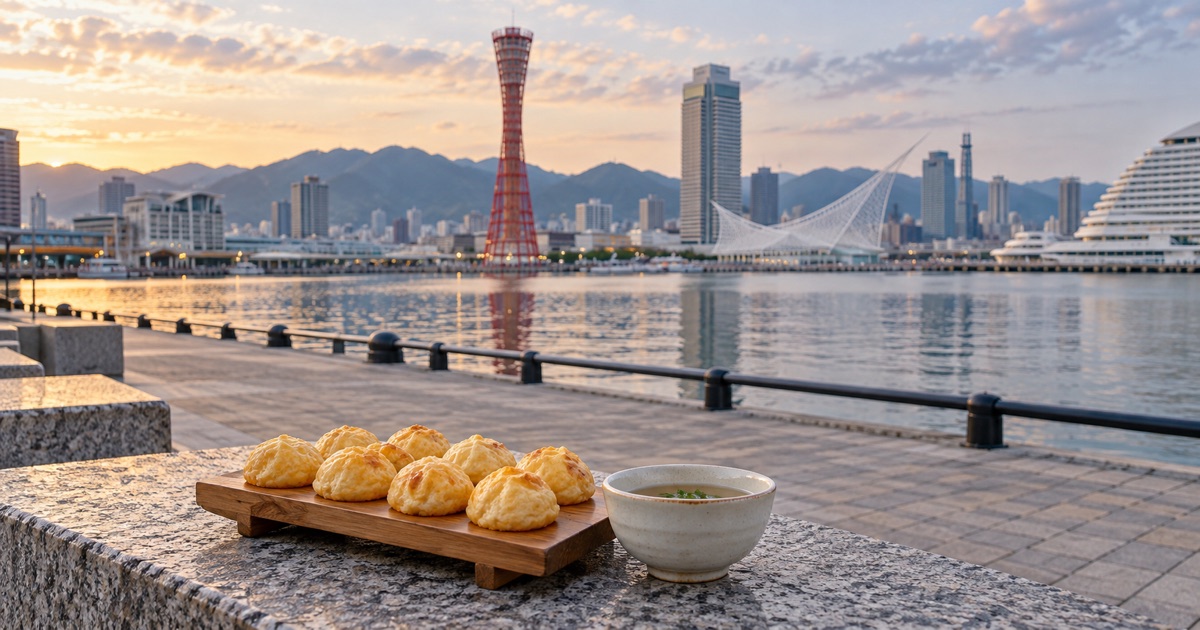
When an order arrives, it sits on a distinctive slanted wooden board alongside a small bowl of clear, warm dashi broth.
- Pick up a steaming dumpling with your chopsticks.
- Submerge it completely into the dashi for 2 to 3 seconds. The broth cools the surface slightly while infusing the egg custard with savory kelp and bonito flavors.
- Add fresh mitsuba (Japanese wild parsley) into the broth if provided.
Port Heritage: Bakeries, Western Sweets, and Nankinmachi
Because Kobe received foreign merchants early, it developed traditions unseen in many other Japanese cities.
Kobe Bread and Pastries (Yogashi, 洋菓子)
Kobe locals consume some of the highest amounts of bread per household in Japan. French baguettes, German rye breads, and delicate Danish pastries fill independent bakeries across the Kitano (北野) and Motomachi (元町) neighbourhoods. The city is equally renowned for Western-style confectionery shops selling baked cheesecakes, cream puffs, and butter cookies.
Nankinmachi (南京町) Chinese Cuisine
Kobe features one of Japan’s three major historic Chinatowns, located near Motomachi Station (元町駅). The compact pedestrian avenues are lined with food carts selling hand-held delicacies:
- Butaman (豚まん): Steamed yeast buns stuffed with seasoned diced pork and sweet onions. Eat carefully, as the interior juices are boiling hot.
- Xiao Long Bao (小籠包): Soup dumplings served in small paper cups. Pierce the skin first to sip the broth before eating the dumpling.
Nada Sake District (灘五郷)
The coastal strip stretching eastward from Kobe is the Nada-Gogō, Japan's largest sake-producing region by volume. The area benefits from mineral-rich groundwater flowing from Mount Rokko (known as Miyamizu) and high-grade Yamada Nishiki sake rice grown nearby.
Many historic breweries maintain visitor centres where travelers can sample freshly pressed, unpasteurised sake (namazake) that is rarely exported. Tastings typically cost between 200 yen and 500 yen for a flight of small glasses.
Comparison: Kobe Beef vs. Soba-meshi
| Feature | Kobe Beef (Teppanyaki) | Soba-meshi |
|---|---|---|
| Dining Atmosphere | Quiet, reserved counter seating | Lively, casual local diners |
| Typical Cost | 4,000 to 25,000+ yen | 700 to 1,200 yen |
| Reservation Needed | Recommended or essential | Rarely needed; walk-in friendly |
| Primary Texture | Melt-in-the-mouth, tender | Chewy noodles, crisp toasted rice |
| Common Allergens | Soy, wheat (in sauces) | Wheat, soy, beef, seafood extracts |
Essential Tips for First-Time Visitors
- Carry Cash for Casual Spots: While teppanyaki restaurants accept international credit cards, small soba-meshi diners and Chinatown food stalls often accept only Japanese yen cash or local IC transit cards (such as ICOCA or Suica).
- Navigating Train Terminals: Kobe’s main transit and dining hub is Sannomiya (三宮), served by JR, Hankyu, and Hanshin lines. It sits about 1.5 km south of the Shin-Kobe Shinkansen Station (新神戸駅); take the Seishin-Yamate subway line for a quick 2-minute connection between them.
- Dietary Notes: Halal-certified and kosher options for Kobe beef require advance research and booking, as only select licensed vendors provide certified handling. For nutritional values of various beef cuts and grains, see official reference charts via the MEXT Food Composition Database.
- Check Operating Hours: Many independent griddle shops and bakeries close on Tuesdays or Wednesdays and shut down once their daily ingredient prep runs out. Always check official shop websites or official local tourism portals before heading out.
FAQ
- Q. Is Kobe beef the only famous food in Kobe?
- A. No, while Kobe beef is internationally famous, the city is also celebrated for soba-meshi, Akashiyaki dumplings, Nada sake, and Western-style bakeries.
- Q. How much does a meal of Kobe beef cost?
- A. Teppanyaki lunch sets generally range from 4,000 yen to 8,000 yen, while multi-course dinners often range between 10,000 yen and 30,000 yen or more depending on the cut and grade.
- Q. How do you order soba-meshi?
- A. Soba-meshi is ordered at casual teppan (iron griddle) diners and okonomiyaki shops, where you specify your protein toppings, such as stewed beef tendon (suji-kon).
Cite or share this article
Copy the link below. If you quote this article, please link to this page as the source.