Aomori Food Guide: Regional Dishes and How to Eat Them
Key takeaways
- Aomori food features cold-climate hot pots, fresh seafood from three surrounding seas, and famous orchard apples.
- Nokkedon allows diners to build custom seafood rice bowls using prepaid ticket sheets at local fish markets.
- Winter stews like senbei jiru use crisp wheat crackers that soften into chewy dumplings inside hot broth.
Aomori food is defined by fresh seafood from three surrounding seas, hearty winter hot pots, and Japan's most celebrated apple harvests. Located at the northern tip of Honshu, this cool-climate prefecture pairs rich coastal catches with warming comfort foods designed to withstand severe northern winters.
For visitors travelling north from Tokyo via the Tohoku Shinkansen line, dining in Aomori (青森) offers a distinct break from central Japanese cuisine. Local menus emphasise bold broths, preserved ingredients, garlic, and rustic wheat staples alongside pristine seasonal fish.
Essential Seafood Dishes of Aomori
Aomori borders the Sea of Japan, the Pacific Ocean, and the Tsugaru Strait. This unique geography creates strong ocean currents that yield firm, sweet seafood throughout the year.
Nokkedon (のっけ丼)
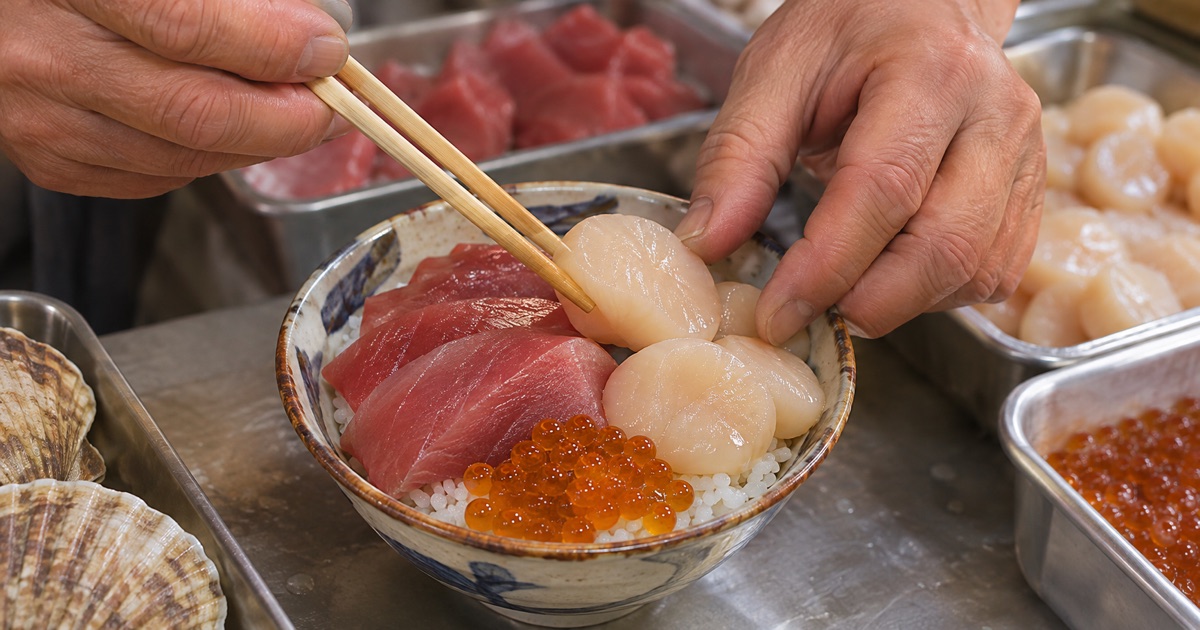
Nokkedon is a custom seafood rice bowl unique to local market halls in Aomori City. Instead of ordering a fixed set menu, diners purchase a strip of tickets and walk through market aisles, selecting individual portions of raw fish, roe, and shellfish to place directly onto a bowl of hot steamed rice.
To enjoy nokkedon without speaking Japanese:
- Walk to the information counter near the market entrance and purchase a ticket booklet (usually priced around 1,500 to 2,000 yen, though prices can change).
- Take your booklet to an assigned rice vendor to exchange your first ticket for a bowl of plain white rice.
- Browse the market stalls displaying small plates of sashimi, scallops, salmon roe (ikura), sea urchin (uni), and tuna.
- Point to the toppings you want. The vendor will collect the required number of tickets (usually one to three per item) and arrange the seafood on top of your rice.
- Once your tickets are spent, take your finished bowl to the designated seating tables. Soy sauce, wasabi, and pickled ginger are provided on the tables.
Allergen note: Nokkedon contains raw finfish, crustaceans, and mollusks. Cross-contact is common across market counters.
Mutsu Bay Scallops (ホタテ, Hotate)
Mutsu Bay produces exceptionally sweet, plump scallops due to mineral-rich runoff from surrounding mountain forests. In Aomori, scallops are eaten raw as sashimi, grilled over charcoal with butter and soy sauce, or baked on the half-shell.
A beloved home-style preparation is kaiyaki miso (貝焼き味噌). Cooks use a large, seasoned scallop shell as a cooking pan over a small tabletop flame. Dashi broth, miso, chopped fresh scallops, and beaten egg are simmered inside the shell until the mixture forms a soft, savoury custard. Scoop the mixture directly over plain rice to eat it.
Tsugaru Strait Tuna (大間マグロ, Oma Maguro)
Pacific bluefin tuna caught off the northern cape of Oma (大間) is regarded as some of the highest-grade tuna in Japan. The fish feed on squid in cold, fast-moving currents, developing intense fat marbling. While premium cuts can be expensive, casual diners can sample fresh lean meat (akami), medium-fatty (chutoro), or minced tuna rice bowls across coastal ports.
Comforting Soups and Regional Noodles
Northern Honshu winters demand steaming, caloric comfort foods. Aomori features several distinct soup and noodle traditions found nowhere else in Japan.
Senbei Jiru (せんべい汁)
Senbei jiru is a traditional hot pot originating in the Hachinohe (八戸) region in southeastern Aomori. The dish combines a soy sauce-based chicken or pork dashi broth with burdock root, mushrooms, leeks, and broken pieces of nambu senbei (南部せんべい)—a sturdy, plain wheat cracker.
Unlike snack crackers made from rice, these wheat crackers are baked specifically to hold their structure in boiling liquid. As they simmer, the crackers absorb the savoury broth and develop a chewy texture similar to fresh pasta or dumplings. Eat the crackers and vegetables together using chopsticks, sipping the broth from your bowl.
Miso Curry Milk Ramen (味噌カレー牛乳ラーメン)
Miso curry milk ramen emerged in Aomori City during the 1970s and remains a local institution. The soup base combines rich red or white miso, curry powder, milk, and chicken-and-pork stock, finished with a pat of butter, bean sprouts, bamboo shoots, and sliced chashu pork.
Despite the unusual combination of ingredients, the milk softens the spice of the curry, while the miso provides a deep, savoury foundation. Mix the pat of melting butter into the broth with your chopsticks before eating the curly, yellow noodles.
Tsugaru Niboshi Ramen (津軽煮干しラーメン)
Niboshi ramen relies on a dark, intensely aromatic broth brewed from dried baby sardines (niboshi). In western Aomori's Tsugaru region, shops serve two variations: a light, clear soy broth meant for daily eating, and a thick, cloudy style simmered with pork bones until creamy and gray. The soup carries a pronounced savoury, slightly bitter fish aroma and is traditionally paired with thick, soft noodles.
We are working to carry Japanese craft and everyday culture beyond Japan, by building Japan Towns with local partners.
Read the Japan Town plan →Preserved Foods and Mountain Ingredients
Historical isolation during snowy winters led Aomori communities to master curing, salting, and fermenting techniques.
- Kenchin-jiru and Ke-no-jiru (けの汁): A vegetarian-based porridge-soup eaten during winter festivals. Root vegetables like daikon radish, carrots, burdock, and freeze-dried tofu are diced into tiny, uniform cubes and simmered in a dashi and miso base.
- Igamenchi (イカメンチ): Originating in Hirosaki (弘前), these savoury patties consist of minced squid tentacles, onions, and seasonal vegetables bound with flour and egg, then pan-fried or deep-fried. They are chewy, savoury, and commonly served in casual izakaya pubs.
- Aomori Garlic: Aomori produces the majority of Japan's domestic garlic, especially around the town of Takko (田子). Cloves are mild, aromatic, and large. Visitors will encounter roasted whole garlic heads, garlic-infused ramen oils, and sweet-savoury dipping sauces throughout local diners.
For more details on seasonal agriculture and regional food culture across Japan, consult the Ministry of Agriculture, Forestry and Fisheries.
Aomori Apples: From Orchard to Table
Aomori produces more than half of Japan's commercial apple crop, centred around the sunny plains near Mount Iwaki in Hirosaki. The region cultivates dozens of varieties, including sweet Fuji, crisp Tsugaru, and pale green Toki.
Fresh Apples
Fresh apples are in peak harvest from September through November, though cold-storage technology makes high-grade fruit available year-round. Supermarkets, train station kiosks, and roadside stations (michi-no-eki) sell individual apples bagged for travel. Japanese apples are typically larger and sweeter than Western supermarket varieties and are traditionally peeled and sliced into wedges rather than eaten skin-on.
Apple Confections and Drinks
Travellers will find apple products integrated into nearly every food category in the prefecture:
- Apple Pies: Hirosaki produces dozens of distinct bakery styles, ranging from French-style flaky tarts to rustic turnover pastries spiced with cinnamon.
- Cider and Juices: Aomori produces dry, sparkling hard ciders as well as pure, cloudy apple juices that list specific cultivars on the label. Vending machines inside major train stations, such as Shin-Aomori Station (新青森駅), often dispense single-variety chilled apple juices.
- Sweets: Apple-infused soft serve ice cream, dried apple chips, and sponge cakes filled with whole stewed apple rings are ubiquitous souvenir gifts (omiyage).
Practical Dining Tips for Visitors
- Navigating Market Counters: English menus are rare in municipal fish markets. Pointing works well; holding up fingers to indicate quantity is universally understood.
- Payment Methods: Major train station restaurants accept IC transport cards (such as Suica) and credit cards. However, stalls inside fish markets, morning street markets, and neighbourhood ramen shops often accept cash only. Carry small bills (1,000 yen notes) and coins.
- Ticket Vending Machines: Many casual ramen and noodle shops use an automated ticket machine (shokkenki) at the entrance. Insert your cash first, press the button corresponding to your dish, and hand the printed paper slip to the kitchen staff when seated.
- Winter Travel Planning: Snow in Aomori can cause transport delays from December through March. If travelling between Aomori City, Hirosaki, or Hachinohe to dine, build generous time buffers into your rail schedule. Check national travel guidelines via the Japan National Tourism Organization before your trip.
FAQ
- Q. What food is Aomori famous for?
- A. Aomori is famous for crisp apples, fresh seafood like scallops and squid, senbei jiru (cracker stew), and miso curry milk ramen.
- Q. How do you order nokkedon in Aomori?
- A. Purchase a ticket booklet at the market entrance, exchange tickets for a rice bowl, and trade remaining tickets for seafood toppings.
- Q. What allergens are common in Aomori dishes?
- A. Shellfish (scallops), finfish, soy, and wheat (present in soup broths and nambu senbei crackers) are widespread across local menus.
Cite or share this article
Copy the link below. If you quote this article, please link to this page as the source.