Kagoshima Food Guide: What to Eat in Southern Kyushu
Key takeaways
- Kagoshima's signature specialties include Kurobuta Berkshire pork, Satsuma-age fried fishcakes, and tender chicken sashimi.
- Sweet potato shochu, tonkotsu simmered pork ribs, and Kagoshima-style tonkotsu ramen define the prefecture's rich savory palate.
- Look out for common allergens such as soy, wheat, egg, sesame, and raw poultry when dining across the region.
Kagoshima food is defined by rich Kurobuta Berkshire pork, fresh coastal seafood, deeply flavorful chicken, and sweet accents derived from local brown sugar and sweet potatoes. Located at the southwestern tip of Kyushu beneath the smoking volcano Sakurajima, this prefecture has developed a bold culinary identity distinct from the rest of Japan.
For international visitors, eating in Kagoshima offers an exceptional look at regional Japanese cooking that balances hearty simmered meats with fresh sashimi and iconic chilled desserts. This guide explains what Kagoshima specialties exist, how to eat them, and what to keep in mind when ordering.
What Are the Must-Try Kagoshima Specialties?
Kagoshima's subtropical climate and volcanic soil have nurtured premium livestock breeds and sweet root crops for centuries.
Kagoshima Kurobuta (鹿児島黒豚)
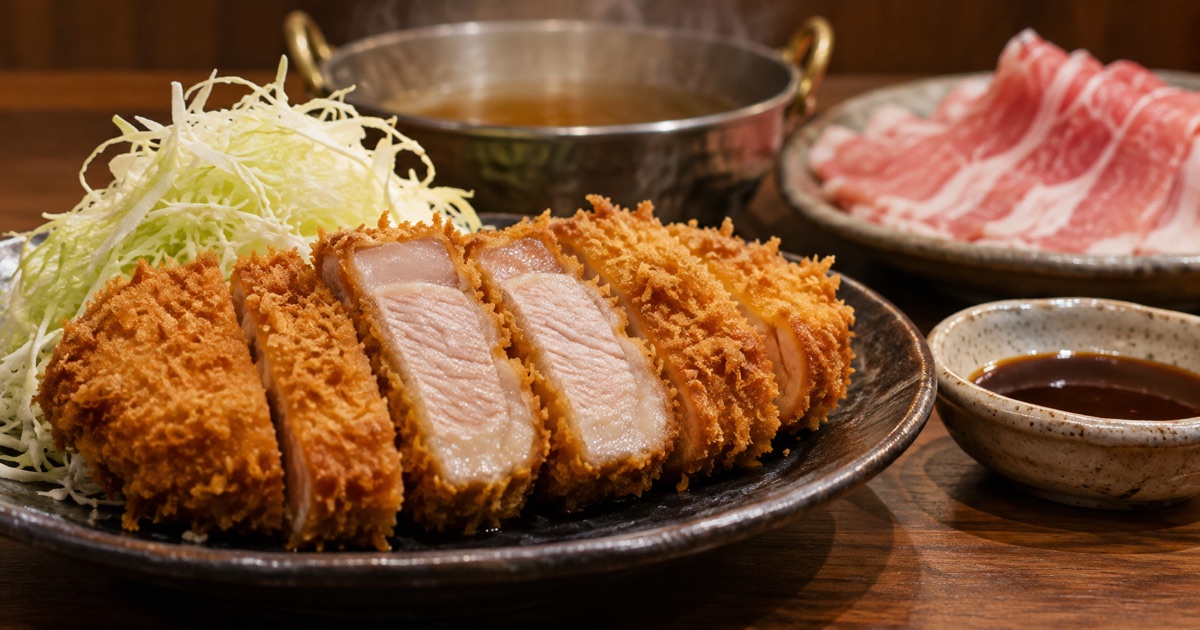
Kagoshima Kurobuta is the prefecture's world-renowned Berkshire black pork. Fed on a diet that historically and traditionally includes local Satsuma sweet potatoes (さつまいも, satsuma-imo), the meat features high marbling, firm white fat that melts at low temperatures, and a naturally sweet, clean finish. According to data tracked by the Ministry of Agriculture, Forestry and Fisheries, Kagoshima stands as one of Japan's leading producers of high-quality pork.
You will encounter Kurobuta primarily in two preparations:
- Kurobuta Tonkatsu (黒豚とんかつ): Thick-cut pork cutlets breaded in panko and deep-fried to a golden crunch. The fat cap on rosu (loin) cuts has a sweet, buttery quality unique to the breed.
- Kurobuta Shabu-Shabu (黒豚しゃぶしゃぶ): Paper-thin pork slices gently swished through hot dashi broth. Unlike beef shabu-shabu, which often uses sesame sauce, Kagoshima pork shabu-shabu is frequently served with a light soba-style dashi dipping broth seasoned with finely sliced scallions and yuzu pepper (yuzukosho).
Satsuma-age (さつま揚げ)
Satsuma-age is deep-fried fishcake made by grinding white fish surimi into a paste, seasoning it with local sake, salt, and brown sugar, and deep-frying it until golden-brown on the outside. In Kagoshima, locals refer to it simply as tsuke-age (つけ揚げ).
Plain versions have a bouncy, tender texture, but you will also find varieties mixed with burdock root (gobo), carrots, cheese, lotus root, or sweet potato. It is served warm straight from street vendors or lightly grilled at izakaya pubs as an accompaniment to drinks.
Torisashi (鳥刺し)
Kagoshima is one of the few places in Japan with a deep-rooted cultural tradition of eating chicken sashimi, known locally as Torisashi. The dish typically features thinly sliced breast (mune), thigh (momo), or liver from Kagoshima Jidori (local heritage breed chickens), often lightly seared on the outer edge to add a smoky aroma while leaving the interior raw. It is dipped in sweet soy sauce mixed with grated ginger or garlic.
Important Note: While Kagoshima enforces strict prefectural safety and slaughterhouse processing standards for Torisashi, the consumption of raw poultry carries an inherent risk of bacterial foodborne illness (such as Campylobacter). Travelers who are pregnant, traveling with small children, or managing weakened immune systems should choose fully cooked chicken dishes like nanban or yakitori instead.
Kagoshima Ramen (鹿児島ラーメン)
Unlike the dense, milky pork-bone broths found in Fukuoka's Hakata ramen, Kagoshima ramen is unique among Kyushu styles. The soup is typically a semi-clear or cloudy broth simmered from pork bones alongside chicken carcasses, dried bonito flakes, and aromatic vegetables, yielding a milder, comforting flavor profile.
Characteristics of Kagoshima ramen include:
- Noodles: Medium-thick, pale white, and slightly soft, rather than thin and firm.
- Toppings: Plentiful stewed bean sprouts, charred garlic, scallions, sweet-savory braised chashu pork, and lightly blanched local cabbage.
- Pickled Daikon (Takuan): Nearly every Kagoshima ramen shop provides a bowl of complimentary, lightly salted pickled daikon radish on the counter to eat with tea while waiting for your noodles.
Tonkotsu Simmered Pork (豚骨)
Not to be confused with ramen broth, traditional Kagoshima tonkotsu refers to bone-in pork ribs or pork belly stewed for hours with local sweet potato shochu, dark brown sugar (kurozato), sweet soy sauce, and ginger. Long braising renders the meat so tender it pulls away from the bone with chopsticks, while the collagen melts into a rich, glossy glaze. It is often served with chunks of daikon radish and konjac jelly.
Keihan (鶏飯)
Originating in the Amami Islands (奄美群島) south of mainland Kagoshima, Keihan translates literally to "chicken rice." It is a delicate, interactive meal: you receive a bowl of steamed white rice and an array of colorful toppings arranged on a platter—shredded chicken breast, paper-thin egg strips (kinshi tamago), sweet-stewed shiitake mushrooms, pickled papaya or ginger, chopped scallions, and crushed nori seaweed.
You arrange your desired toppings over the rice, then ladle piping-hot, clear chicken broth over the entire bowl, eating it like a savory rice soup or ochazuke.
Shirokuma (白熊)
For dessert, Kagoshima is famous for Shirokuma, which means "polar bear." This towering mountain of finely shaved, fluffy ice is generously drizzled with condensed milk and sweet syrup, then decorated with fresh fruits (such as mandarin oranges, melon, bananas, and cherries) and sweet red adzuki beans. When viewed from above, the arrangement of fruit and beans traditionally resembles the face of a bear. Shirokuma is available year-round in cafes, dessert shops, and convenience stores throughout the prefecture.
How to Order and Eat Kagoshima Specialties
Navigating local eateries is straightforward once you understand standard dining formats:
- Tonkatsu Restaurants: You will generally be asked to choose between hire (ヒレ, lean tenderloin) and rosu (ロース, richer loin with a strip of fat). Sets include rice, miso soup, shredded cabbage, and pickles. Rice and cabbage refills are often free of charge; look for the term okawari (おかわり).
- Shabu-Shabu Establishments: Wait for the hot pot broth to simmer, take a slice of pork with your chopsticks, and swish it through the liquid for roughly 10 to 15 seconds until the pink color turns white. Do not leave the delicate meat unattended in the pot, as overcooking toughens Berkshire pork. Dip the cooked meat into the seasoned dashi or sauce provided.
- Izakaya (Japanese Pubs): Satsuma-age and simmered tonkotsu are standard pub staples. Simply point to the menu or write items down. Satsuma-age is eaten either by hand or with chopsticks, sometimes with a dab of soy sauce and grated ginger or hot mustard (karashi).
We are working to carry Japanese craft and everyday culture beyond Japan, by building Japan Towns with local partners.
Read the Japan Town plan →Regional Drink Pairing: Satsuma Shochu
Kagoshima is one of the few prefectures in Japan with almost no traditional sake breweries. Instead, it is the home of authentic imo-shochu (芋焼酎)—a distilled spirit crafted from volcanic-soil sweet potatoes and koji mold.
When ordering shochu at a Kagoshima restaurant, staff will ask how you want it served:
- Oyuwari (お湯割り): Mixed with hot water. The classic Kagoshima method, usually poured in a 6:4 ratio (hot water first, then shochu). The steam releases the earthy sweetness and rich aroma of the potato.
- Mizuwari (水割り): Mixed with cold water and ice, giving a milder, lighter profile.
- Rokku (ロック): On the rocks (over ice).
- Straight (ストレート): Neat, at room temperature.
Practical Travel and Dining Tips
Typical Cost Ranges
Dining in Kagoshima is generally good value compared to central Tokyo. While prices change over time, general daytime expectations include:
- Kagoshima Ramen: Roughly 750 to 1,100 yen per bowl.
- Kurobuta Tonkatsu Set: Around 1,500 to 2,800 yen depending on cut and grade.
- Kurobuta Shabu-Shabu Dinner: Around 3,000 to 6,000 yen per person.
- Satsuma-age (per piece at stations/markets): Roughly 120 to 250 yen.
- Shirokuma Shaved Ice: Around 600 to 1,200 yen depending on portion size.
Always check shop notices or official web listings for up-to-date pricing and current hours.
Common Allergens and Dietary Notes
- Soy and Wheat: Used extensively in broths, sweet soy sauces, ramen tare, and Satsuma-age seasoning.
- Egg: Present in the panko breading for tonkatsu and frequently used as a binder in commercial Satsuma-age.
- Fish and Seafood: Fish surimi is the base for Satsuma-age, and bonito dashi is present in most noodle soups and shabu-shabu dipping sauces.
- Vegetarian/Vegan Dining: Can be challenging in Kagoshima due to the prominence of pork, chicken, and fish dashi in traditional bases. Verify ingredients directly using translation apps or check tourism guides via the Japan National Tourism Organization before visiting.
Navigating the Area
Most premier dining establishments in Kagoshima City are clustered around two walkable transit hubs connected by a quick 5-to-10-minute tram ride: Kagoshima-Chuo Station (鹿児島中央駅, the Shinkansen terminus) and Tenmonkan (天文館, the city's main covered shopping and entertainment arcade). Carrying cash is advisable, as smaller noodle shops and traditional izakaya may not accept credit cards or digital transit IC cards.
FAQ
- Q. What is the most famous food in Kagoshima?
- A. Kagoshima is most famous for Kagoshima Kurobuta (鹿児島黒豚), a pedigree Berkshire pork celebrated across Japan for its melt-in-the-mouth fat, delicate sweetness, and tender texture when served as tonkatsu or shabu-shabu.
- Q. Is it safe to eat raw chicken (torisashi) in Kagoshima?
- A. Kagoshima has strict prefectural hygiene and processing standards for Torisashi (鳥刺し), but eating raw poultry always carries a risk of bacterial foodborne illness; travelers who are pregnant, elderly, or immunocompromised should avoid raw meat.
- Q. How does Kagoshima ramen differ from Hakata ramen?
- A. Kagoshima ramen uses a lighter broth blended from pork bones, chicken stock, and vegetables, paired with thicker, softer noodles and topped with charred scallions, wood ear mushrooms, and cabbage, unlike the thin noodles and purely rich tonkotsu broth of Hakata.
Cite or share this article
Copy the link below. If you quote this article, please link to this page as the source.