Fukuoka Food Stalls Guide: Yatai Dishes and How to Eat
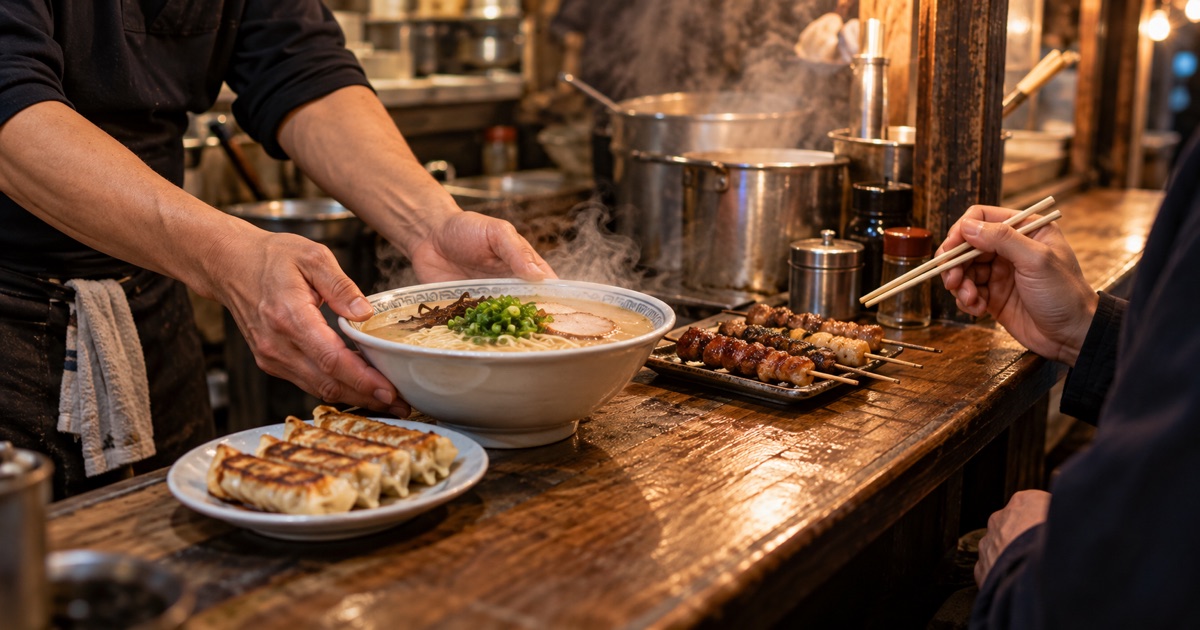
Key takeaways
- Fukuoka yatai are compact open-air mobile food carts serving ramen, gyoza, yakitori, and regional dishes.
- Most stalls accommodate roughly 8 to 12 seated guests, making cash payment and prompt dining essential etiquette.
- Common street food ingredients include pork, soy, wheat, and eggs, so travellers with allergies should check carefully.
Fukuoka food stalls, known locally as yatai (屋台), are mobile open-air dining carts that define the culinary nightlife of northern Kyushu. Operating primarily in areas like Nakasu (中洲), Tenjin (天神), and Nagahama (長浜), these intimate street carts serve regional comfort foods such as Hakata tonkotsu ramen, bite-sized pan-fried dumplings, and skewered grilled meats to small groups of diners seated shoulder-to-shoulder.
For travellers visiting Fukuoka without Japanese language skills, eating at a street cart is an accessible and social way to experience regional food culture. Knowing what foods are served, how the ordering process functions, and what basic etiquette to observe ensures a smooth meal.
What Are Fukuoka Food Stalls?
A yatai is a traditional wooden food wagon wheeled onto pedestrian walkways or open plazas in the late afternoon, assembled for evening business, and dismantled entirely before morning. Each stall features a small central kitchen counter surrounded by stools under a canvas awning or vinyl curtain.
Most stalls seat roughly 8 to 12 customers at a time. The atmosphere is casual, energetic, and close-quarters, where tourists, office workers, and locals sit side by side. Space is strictly limited, meaning customers sit close to each other and share condiments, seasonings, and paper napkins laid out along the counter.
Because stalls operate under open skies, bad weather such as heavy rain, high winds, or typhoons will cause many vendors to close without advance notice. When planning an evening around street dining, consult resources such as the Japan National Tourism Organization to check regional travel advisories and public transport updates.
Classic Dishes Served at Fukuoka Yatai
Fukuoka street carts focus on fast-cooking, high-heat dishes that pair well with drinks. While menus differ between carts, several quintessential dishes appear across most locations.
Hakata Tonkotsu Ramen (博多豚骨ラーメン)
Allergen note: This dish contains wheat, soy, and pork; some broths also incorporate sesame or shellfish extracts.
Hakata-style ramen is the signature offering of Fukuoka street carts. The dish features a milky white broth made by boiling pork bones (tonkotsu) at high heat for hours, releasing gelatin and marrow into the soup. It is served with ultra-thin, straight wheat noodles (hosomen), topped with sliced braised pork belly (chashu), finely chopped green onions (negi), and wood-ear mushrooms (kikurage).
When ordering noodles in Fukuoka, vendors often ask how firm you prefer your noodles cooked. Common firmness levels include:
- Futsu (普通): Normal
- Katame (硬め): Firm
- Barikata (バリカタ): Very firm
If broth remains in your bowl after finishing the noodles, diners can order an extra noodle refill called kaedama (替え玉) for a small additional cost. Do not finish all of your broth if you intend to order kaedama, as fresh broth is not added with the refill.
Hitokuchi Gyoza (一口餃子)
Allergen note: Wrappers contain wheat; filling typically contains pork, soy, garlic, chives, and sesame oil.
Unlike standard Japanese dumplings, Fukuoka's bite-sized hitokuchi gyoza are miniature pan-fried dumplings. Vendors pack them tightly onto a flat iron griddle to create a crispy bottom crust while keeping the interior juicy. They are traditionally eaten dipped in a light blend of soy sauce, vinegar, and spicy citrus pepper known as yuzukosho (柚子胡椒).
Yakitori (焼き鳥)
Allergen note: Seasoning sauces usually contain soy and wheat; cross-contamination on shared open grills is common.
Although yakitori literally means grilled chicken, Fukuoka stalls use the term broadly to cover skewered meats of all types cooked over charcoal or gas flames. A staple order is butabara (豚バラ), or skewered pork belly, seasoned with salt. Other skewers include chicken thigh with scallions (negima), chicken meatballs (tsukune), and bacon wrapped around enoki mushrooms or quail eggs. Guests choose between a simple salt seasoning (shio) or a sweet-savory soy glaze (tare).
Oden (おでん)
Allergen note: Broth contains fish stock (dashi) and soy; ingredients commonly include eggs, wheat-based fish cakes, and tofu.
Visible in large, compartmentalized metal simmering pots on the counter, oden features various ingredients slowly steeped in a light dashi broth flavored with soy sauce and mirin. Popular items include:
- Daikon (大根): Thick cuts of Japanese white radish, tender and saturated with broth.
- Tamago (玉子): Hard-boiled eggs simmered until savory.
- Atsuage (厚揚げ): Fried tofu blocks with a soft interior.
- Chikuwa (ちくわ): Tube-shaped processed fish cakes.
Diners generally order individual items one by one. The cook scoops the selected piece into a small bowl, ladles hot broth over it, and dabs sharp Japanese mustard (karashi) onto the rim.
Yatai Specialities: Yaki Ramen and Mentaiko Dishes
Some stalls offer yaki ramen (焼きラーメン), a stir-fried street noodle dish invented in Fukuoka. Boiled ramen noodles are stir-fried on an iron flat top with pork, vegetables, tonkotsu broth, and Worcestershire-style sauce.
You will also find items utilizing spicy cured cod roe, known as mentaiko (明太子). Common variations include mentai tamagoyaki (rolled omelette stuffed with seasoned roe) and mentaiko-crusted chicken skewers.

We are working to carry Japanese craft and everyday culture beyond Japan, by building Japan Towns with local partners.
Read the Japan Town plan →How to Eat at a Yatai in 5 Steps
Approaching a street food stall for the first time without speaking Japanese is simple if you follow this 5-step process.
- Check for open seats: Stand near the entrance opening of the vinyl curtain and make eye contact with the operator. Indicate the number of guests in your party with your fingers. Wait to be gestured to a specific open seat; do not squeeze into a bench uninvited.
- Order a beverage first: In Japanese casual dining culture, it is standard practice to order a drink upon sitting down. Stalls offer Japanese draft beer, highballs (whisky with soda), shochu (distilled spirits, served with water, hot water, or ice), and soft drinks like oolong tea.
- Place your initial food order: Point to menu boards or make simple selections from the display case. Food stalls are meant for quick dining; order two or three items to start rather than overloading the small kitchen counter all at once.
- Pass empty dishes back up: Because counter depth is narrow, place empty plates and glasses back onto the upper shelf of the counter once finished to make room for your next dishes.
- Request the bill and vacate the seat: Signal the cook that you are ready to pay by crossing your index fingers into an "X" or saying O-kaikei (お会計). Pay in cash, collect your belongings, and yield your stool to waiting customers outside.
Practical Advice and Etiquette for Visitors
To navigate Fukuoka food stalls comfortably, keep these practical points in mind:
- Carry Physical Cash: Credit cards, transport IC cards, and international smartphone payment apps are rarely accepted at temporary street carts. Bring Japanese yen in ¥1,000 notes and coins.
- Pack Light: There are no coat racks, luggage rooms, or storage shelves in a street cart. Avoid bringing large suitcases or oversized backpacks into the seating area. Keep personal items small enough to rest on your lap.
- Bathroom Planning: Stalls do not contain plumbing for private restrooms. Operators can point you toward nearby public restrooms in riverside parks, underground subway corridors, or public convenience stores. Locate one before sitting down to eat.
- Keep Visits Concise: When queues form outside the curtain, lingering over an empty plate is frowned upon. A standard stay at a single stall typically ranges roughly between 30 and 50 minutes. If you want more food or drink, hop to a different stall or neighborhood pub.
- Dietary Considerations: Stalls operate within extremely confined prep spaces with shared cookware, tongs, and cutting boards. Strict vegetarian, vegan, or severe gluten-free accommodations are difficult to guarantee in this environment. For ingredient breakdowns and standards, consult resources such as the Ministry of Agriculture, Forestry and Fisheries.
Finding Stall Locations in Fukuoka
Most stalls assemble around three main hubs across the city:
- Nakasu (中洲): Set along the Naka River, this row of carts is the most scenic and famous among international tourists. It is easily reachable on foot in roughly 10 minutes from Nakasu-Kawabata Station (中洲川端駅) on the Fukuoka City Subway.
- Tenjin (天神): Clustered around the central commercial streets, major department stores, and subway exits outside Tenjin Station (天神駅). These stalls often serve a steady crowd of local office workers.
- Nagahama (長浜): Located near the city fish market, accessible from Akasaka Station (赤坂駅). Nagahama is the historic birthplace of Nagahama-style ramen, featuring ultra-fast noodle service tailored to market employees.
Operating hours generally start around dusk and run until midnight or slightly later, depending on local weather and ingredient supplies. Checking street food clusters early in the evening offers the easiest opportunity to secure seats without lengthy lines.
FAQ
- Q. What time do Fukuoka food stalls usually open and close?
- A. Most stalls set up at dusk, often operating roughly between 18:00 and midnight, though operating days vary by weather and vendor schedule.
- Q. Can I use credit cards at Fukuoka food stalls?
- A. Cash is the standard payment method at most street carts, so carrying enough Japanese yen in small banknotes and coins is highly recommended.
- Q. Are there restrooms inside Fukuoka yatai stalls?
- A. Food stalls do not have private restrooms; guests use public park facilities, convenience store toilets, or nearby train station restrooms.
Cite or share this article
Copy the link below. If you quote this article, please link to this page as the source.