Nagasaki Food: What to Eat & Why
Key takeaways
- Nagasaki food is shaped by centuries of trade with China, Portugal and the Netherlands, unlike most other Japanese regional cuisines.
- Champon and sara udon are the city's two signature noodle dishes, both built on a similar base but cooked very differently.
- Castella (カステラ) sponge cake is Nagasaki's best-known souvenir sweet and is sold in sealed boxes that travel well.
Nagasaki food is best known for champon, sara udon, and castella, dishes shaped by centuries of trade with Chinese, Portuguese, and Dutch merchants. Unlike regional cuisines that developed in isolation, local menus feature mild and savory flavors that fuse foreign cooking techniques with Japanese ingredients.
あわせて読む:Okinawa Food: A First-Timer's Guide to What to Eat and Why/Tokyo Food: A First-Timer's Guide to What to Eat and Where/Yokohama Food: A First-Timer's Guide to What to Eat and Where
What Food Is Nagasaki Known For?
Nagasaki is known for champon (ちゃんぽん) and sara udon (皿うどん), two noodle dishes born from Chinese immigrant cooking, and for castella (カステラ), a soft sponge cake introduced by Portuguese traders centuries ago. These dishes exist because Nagasaki was one of the only places in Japan open to foreign trade for over 200 years during the Edo period, and that history still shows up on local menus today.
Unlike many Japanese regional cuisines that developed in isolation, Nagasaki's food culture is a genuine fusion of Chinese, Portuguese, Dutch and Japanese cooking techniques. This makes it one of the more unusual and approachable regional cuisines for first-time visitors, since flavors tend to be mild, savory and familiar rather than highly seasoned or unusual in texture.
A Port City's Food Identity
For centuries, Nagasaki's port was Japan's main window to the outside world. Chinese traders settled in the city and brought their own cooking styles, which blended with local Japanese ingredients over generations. Portuguese and Dutch traders later added sugar, eggs and baking techniques that are still visible in Nagasaki's sweets today. Understanding this background helps explain why Nagasaki's food tastes noticeably different from, say, Kyoto's refined kaiseki cuisine or Osaka's street food.
Champon: Nagasaki's Signature Noodle Soup
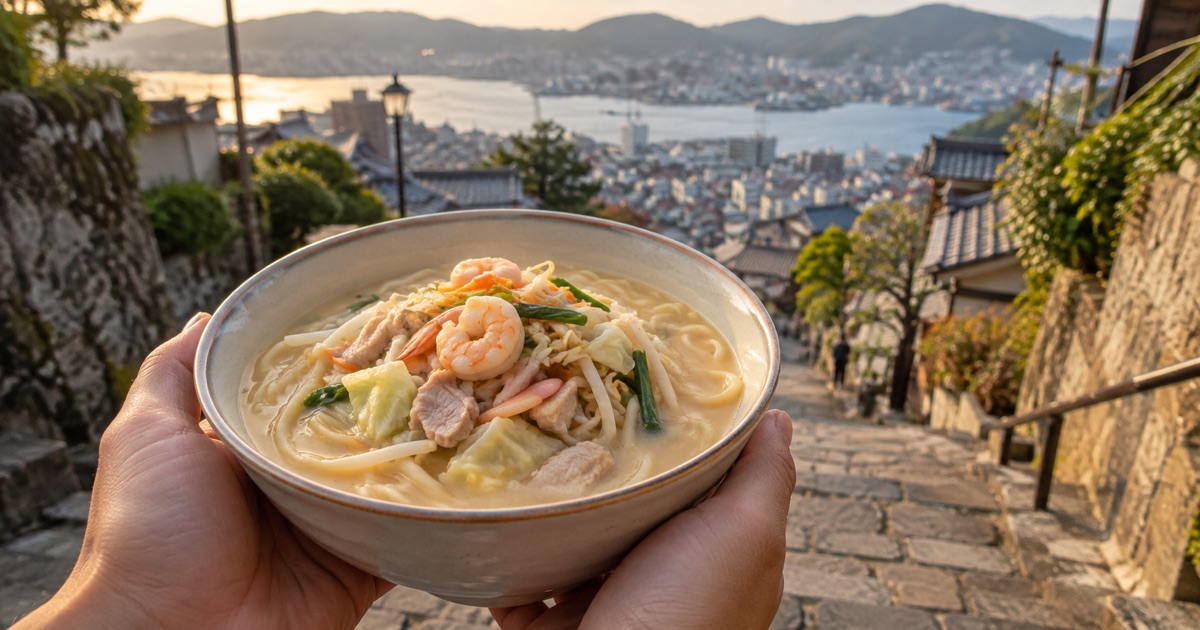
Champon is a one-bowl noodle dish with thick, chewy wheat noodles served in a cloudy, slightly rich broth made from pork bones and chicken stock. The bowl is topped with a generous mix of stir-fried pork, seafood (often squid, shrimp or fish cake), cabbage, bean sprouts and other vegetables, all cooked together in the same pot before the broth and noodles are added.
The name "champon" is believed to come from a Chinese word meaning "to mix," which reflects the dish's origin as a way for Chinese residents in Nagasaki to use whatever ingredients were on hand. It's typically eaten with a spoon for the broth and chopsticks for the noodles and toppings, the same way you'd eat ramen elsewhere in Japan.
Common allergens: champon broth is usually pork- and seafood-based, and most versions are not suitable for those avoiding shellfish, pork or gluten (the noodles contain wheat).
We are working to carry Japanese craft and everyday culture beyond Japan, by building Japan Towns with local partners.
Read the Japan Town plan →Sara Udon: The Crispy Alternative
Sara udon literally means "plate noodles" and uses many of the same toppings as champon, but with a key difference: the noodles are either thin and deep-fried until crisp, or thicker and lightly pan-fried. The stir-fried topping mixture, thickened with a light starch-based sauce, is poured over the noodles just before serving.
Because the noodles are fried rather than boiled in broth, sara udon has a completely different texture from champon, crunchy at first, then softening slightly as the sauce soaks in. Diners often add a dash of Worcestershire-style sauce or vinegar at the table, so don't be surprised to see small bottles of condiments offered alongside the dish. A common mistake first-timers make is waiting too long to eat it; the longer sara udon sits, the softer and less crisp the noodles become.
Castella: Nagasaki's Famous Sponge Cake
Castella is a tall, moist sponge cake made from eggs, flour, sugar and a sweetener called mizuame (a starch-based syrup). It was introduced by Portuguese merchants in the 16th century and adapted over time into something distinctly Japanese: denser and more uniform than Western sponge cake, often with a thin caramelized layer on top and bottom.
It's traditionally sold as a long rectangular loaf and sliced into thick pieces, each with a slightly sticky, fine-grained texture. Castella is a popular souvenir because sealed boxes travel well and keep for a reasonable amount of time, though exact shelf life varies by product, so check the packaging rather than assuming. Some versions include a layer of coarse sugar crystals at the base, which is considered a sign of traditional preparation rather than a flaw.
Common allergens: castella contains egg and wheat, and is not suitable for those with egg allergies.
Other Nagasaki Dishes Worth Knowing
Toruko Rice (Turkish Rice)
Despite the name, this dish has no direct connection to Turkey. It's a plate combining fried rice (or pilaf), a cutlet (often pork), and a portion of spaghetti in tomato sauce, all served together. It reflects Nagasaki's habit of combining dishes from different food cultures onto a single plate, a style sometimes associated with the city's "yoshoku" (Japanese-style Western food) tradition.
Shippoku Cuisine
Shippoku (卓袱料理) is a more formal, multi-course style of dining that blends Japanese, Chinese and Western dishes served on a round table, traditionally meant to be shared. It's less of an everyday meal and more associated with special occasions or set-course dining, so travelers looking for a casual bite are more likely to encounter champon or sara udon instead.
Nagasaki Peixada and Other Portuguese-Influenced Sweets
Beyond castella, Nagasaki has several confections with Portuguese roots, including konpeito (a small, star-shaped sugar candy) and various egg-based sweets. These are generally found in confectionery shops rather than restaurants, and make for easy, compact souvenirs.
How and Where to Try Nagasaki Food
Champon and sara udon are widely available at casual noodle restaurants and Chinese-style eateries throughout Nagasaki city, and many menus include photos, which helps if you don't read Japanese. Prices for a bowl of champon or a plate of sara udon are generally in the range of a casual lunch set in Japan, though exact prices vary by restaurant and can change, so check menus on-site.
If you're visiting from elsewhere in Kyushu, Nagasaki is reachable by train and by air; travel times vary considerably depending on your starting point, so it's worth checking current routes and schedules before planning a day trip, since timetables can change. For broader travel planning, the Japan National Tourism Organization offers up-to-date regional information.
A common mistake visitors make is assuming champon and ramen are interchangeable; while both are noodle soups, champon's broth, noodle thickness and topping style are distinct, and ordering one expecting the other can lead to disappointment. Another point worth noting: not all "champon" served outside Nagasaki is made the same way, so trying it in the city itself gives a more representative version of the dish.
A Food Culture Worth Exploring Slowly
Nagasaki's cuisine rewards travelers who take the time to understand its layered history. Because the city's food developed through long-term contact with Chinese and European traders, many dishes don't fit neatly into typical categories of "Japanese food," which is part of what makes Nagasaki a distinctive stop for food-focused travel in Japan. For general information on Japanese ingredients and nutrition, the Ministry of Agriculture, Forestry and Fisheries provides background resources that can add useful context to regional dishes like these.
FAQ
- Q. What is the most famous food in Nagasaki?
- A. Champon (ちゃんぽん), a noodle soup with pork, seafood and vegetables in a milky pork-and-chicken broth, is generally considered Nagasaki's signature dish.
- Q. Is Nagasaki food spicy?
- A. No. Most Nagasaki dishes, including champon and sara udon, are mild and savory rather than spicy, making them easy for most travelers to eat.
- Q. Can vegetarians eat Nagasaki's local dishes?
- A. It's difficult. Champon and sara udon broths are typically made with pork or chicken stock and often include seafood, so ask staff about ingredients or consider castella and other confections instead.
Cite or share this article
Copy the link below. If you quote this article, please link to this page as the source.