Saitama Food Guide: Must-Try Regional Specialties
Key takeaways
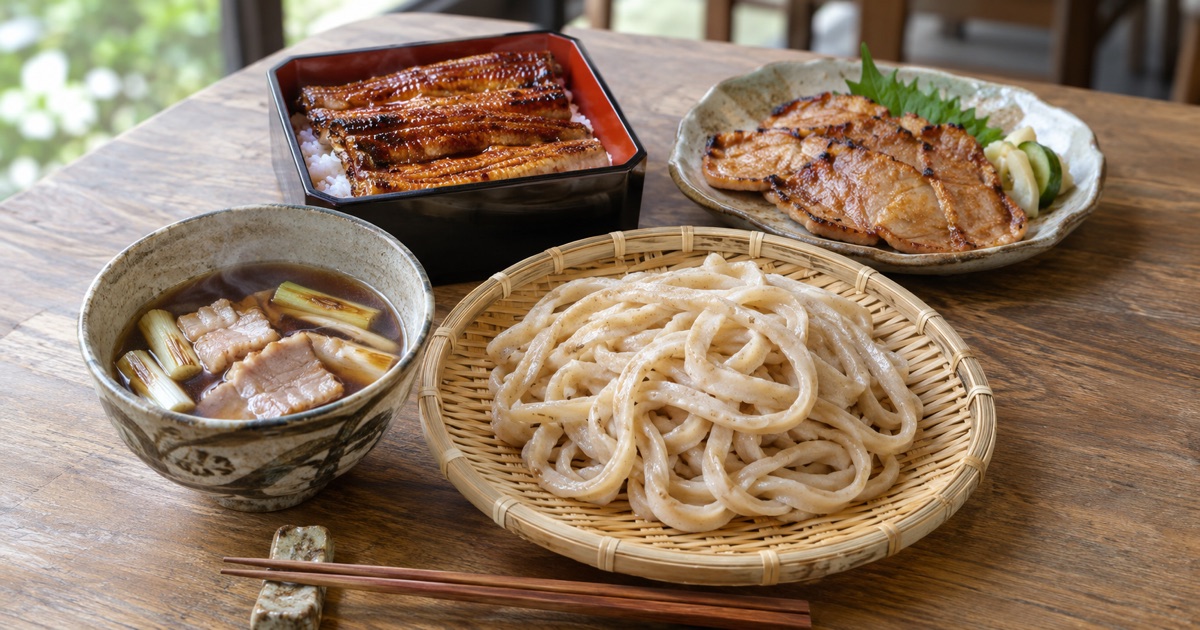
- Saitama is famous for diverse wheat noodles, historic river eel (unagi), and rich miso-cured meats.
- Located roughly 30 to 60 minutes from central Tokyo by train, Saitama offers distinct regional dining traditions.
- Always confirm operating hours and allergen information, as local menus often feature wheat, soy, and pork.
Saitama food features hearty wheat noodles, grilled freshwater eel, and mountain-style pork preserved in fermented bean paste. Located immediately north of Tokyo in the Kanto region, Saitama Prefecture (埼玉県) offers an accessible culinary landscape shaped by fertile river plains, a historic surplus of wheat, and preserved agricultural traditions.
For international travelers planning day trips from Tokyo, Saitama provides an authentic look at traditional Japanese comfort cooking. This guide breaks down the core regional dishes, explains how to order and eat them, and provides practical advice for navigating menus without Japanese language skills.
The Core Staples of Saitama Food
Because northern Kanto historically produced high volumes of wheat rather than just wet-rice agriculture, Saitama evolved into one of Japan's premier noodle territories. Alongside wheat flour dishes, the prefecture's inland river networks and forested mountains created pockets of distinct local fare.
Musashino Udon (武蔵野うどん)
Musashino udon is arguably Saitama’s most iconic regional staple. Unlike the silky, tender udon popular in western Japan, Musashino udon consists of thick, rustic, hand-cut noodles with a firm chew. The dough uses whole-wheat flour, giving the strands an earthy, brownish tint and a hearty wheat aroma.
The noodles are typically boiled, rinsed in cold water, and served on a bamboo mat alongside a hot dipping broth known as tsukejiru (つけ汁). This broth is deep brown, salty-sweet, and made from soy sauce, dashi (kelp and dried fish broth), sweet mirin, and sliced pork belly cooked with chunks of thick Japanese leek (negi).
Urawa Eel (浦和のうなぎ)
In the southern city of Saitama, the Urawa area has been renowned for freshwater eel (unagi, 鰻) since the Edo period (1603–1867). Local fishermen caught wild eel in the marshes and waterways surrounding the Arakawa River, serving them freshly grilled to travelers along the Nakasendo highway.
Today, Urawa eel is prepared in the classic Kanto style: the eel is split down the back, skewered, grilled plain over charcoal, steamed to tenderize the meat, and then glazed with a sweet, dark soy sauce reduction (tare) before a final round of grilling. It is commonly served over a bed of steamed rice inside a lacquered box (unaju).
Chichibu Miso Pork (秩父の豚の味噌漬け)
In Chichibu (秩父), a mountainous basin in western Saitama, hunters historically preserved wild boar meat by packing it in local fermented bean paste (miso). Over time, this method shifted to high-grade domestic pork.
Thinly or medium-sliced pork loin is marinated for days in a savory, slightly sweet miso blend. The meat absorbs the salt and umami of the paste while enzymes tenderize the protein. It is then scraped free of excess paste and charcoal-grilled or pan-fried. The sugars in the miso caramelize quickly over the fire, imparting a smoky, savory crust that pairs naturally with white rice.
Higashimatsuyama Yakitori (東松山やきとり)
Despite the word tori (which usually means chicken), "yakitori" in the city of Higashimatsuyama refers almost exclusively to pork cheek and pork jowl (kashira) skewered with leeks. Introduced in the mid-20th century, this budget-friendly pub food is grilled plain over high heat.
The defining feature is the accompanying condiment: a spicy miso paste flavored with chili peppers, garlic, and sesame oil. Diners receive skewers dry and use a small wooden brush or spoon to paint the thick, red-brown miso sauce directly onto the meat right before eating.
Kawagoe Sweet Potato Specialties (川越のさつまいも)
During the Edo period, the merchant town of Kawagoe (川越) became the primary supplier of sweet potatoes to the capital via river cargo boats. The area embraced the tuber, and today Kawagoe's historic warehouse district produces numerous sweet potato dishes.
These include savory preparations like sweet potato steamed rice (satsumaimo gohan) and tempura, alongside casual street items such as purple sweet potato chips, warm sweet potato paste pastries, and roasted whole tubers (yaki-imo).
How to Order and Eat Regional Specialties
Navigating local dining establishments in Saitama is straightforward once you understand the basic service styles.
Eating Musashino Udon
- Select your noodle size: Menus usually list portions as nami-mori (並盛, regular, roughly 300g to 400g cooked weight), chu-mori (中盛, medium), or dai-mori (大盛, large). Portions in Saitama run significantly larger than standard Tokyo udon shops.
- Dip, do not pour: Pick up two or three strands of noodles with your chopsticks and dip them halfway or fully into the small bowl of hot pork broth.
- Eat the garnishes together: Eat the noodles along with slices of the simmered pork and leek.
- Dilute the broth: Many shops provide a small kettle of unseasoned hot cooking water (udon-yu). At the end of the meal, pour a small splash of this water into your leftover dipping bowl to dilute the salty sauce so you can sip it as a soup.
Ordering Eel and Rice
Eel restaurants generally present streamlined menus centered around unaju (鰻重). Dishes are typically categorized by grades such as Matsu (松, Pine), Take (竹, Bamboo), and Ume (梅, Plum). These tiers do not reflect differences in the quality of the eel; rather, they indicate the weight and portion size of the fish.
Most eel dishes arrive with a small side dish of clear soup (kimosui, made using the eel liver) and pickled vegetables (tsukemono). Before eating, sprinkle a small pinch of green Japanese pepper (sansho, 山椒) over the eel to cut through the rich fat and sweet glaze.
We are working to carry Japanese craft and everyday culture beyond Japan, by building Japan Towns with local partners.
Read the Japan Town plan →Practical Information for Travelers
Getting There from Tokyo
Most major food hubs in Saitama are easily accessible within a short train ride using central Tokyo terminals:
- Omiya / Urawa: Around 30 minutes from Tokyo Station or Shinjuku Station via the JR Ueno-Tokyo Line or JR Saikyo Line.
- Kawagoe: Roughly 30 to 45 minutes from Ikebukuro Station via the Tobu Tojo Line, or from Seibu-Shinjuku Station via the Seibu Shinjuku Line.
- Chichibu: Roughly 75 to 90 minutes from Ikebukuro Station aboard the Seibu Limited Express train.
What to Bring and Prepare
- Cash: While modern chain restaurants accept credit cards and IC transport cards, many historic udon shops, street vendors in Kawagoe, and small roadside eateries in Chichibu operate on a cash-only basis.
- Translation apps: Menus in smaller Saitama towns are rarely translated into English. Having an offline image-translation application ready on your mobile device helps decode ticket-vending machines (kenbaiki).
- Flexibility with hours: Regional shops often close immediately once their daily supply of fresh noodles or broth runs out, which can happen by early afternoon (roughly 14:00). Always check the official website or verified municipal tourism pages for expected operational schedules.
Allergens and Dietary Considerations
Saitama's traditional cuisine relies heavily on core elements that require attention for diners with dietary restrictions:
- Wheat: The dominant regional foods—including all udon varieties and tempura batters—contain gluten. Soy sauce (shoyu), used across virtually every simmered dish, dipping sauce, and eel glaze, also contains wheat.
- Pork: Broths for Musashino udon and the skewers in Higashimatsuyama rely entirely on pork products.
- Fish and Shellfish: Dipping sauces and soups are built upon dashi, which commonly utilizes dried skipjack tuna (katsuobushi) and dried sardines (niboshi).
For broad agricultural information and seasonal food context across the country, travelers can consult the Ministry of Agriculture, Forestry and Fisheries. For nationwide transit access and municipal guidance, refer to the Japan National Tourism Organization.
Common Mistakes to Avoid
- Expecting soft noodles: Visitors unfamiliar with Musashino udon sometimes assume the noodles are undercooked due to their extreme firmness. The chewiness is intentional and prized locally.
- Arriving late in the afternoon: Many rural noodle shops operate only during the midday window (roughly 11:00 to 14:30) and do not open for dinner.
- Assuming "yakitori" is always chicken: In Higashimatsuyama, ordering yakitori will bring you pork jowl unless you specifically seek out chicken skewers.
- Pouring cold noodles into hot broth: Musashino udon is a dipping dish (tsukemen style). Dumping the cold noodles all at once into the small dipping bowl quickly cools the hot broth and dilutes its flavor balance.
References
- Ministry of Agriculture, Forestry and Fisheries (MAFF): Local Cuisine Decoded Directory.
- Saitama Prefectural Government: Regional Agricultural and Food Heritage Archives.
- Japan National Tourism Organization (JNTO): Regional Travel Guides for Saitama Prefecture.
FAQ
- Q. What is the most famous food in Saitama?
- A. Saitama is best known for its diverse udon noodle traditions, including Musashino udon, as well as charcoal-grilled river eel (unagi) and Chichibu miso pork.
- Q. How far is Saitama from Tokyo for a food trip?
- A. Major culinary hubs in Saitama, such as Kawagoe and Omiya, take roughly 30 to 60 minutes by direct train from central Tokyo stations like Shinjuku and Tokyo.
- Q. Are Saitama regional dishes suitable for vegetarians?
- A. Many Saitama dishes rely heavily on pork broth, dried bonito stock (dashi), and meat toppings, making strictly vegetarian options rare outside dedicated specialty shops.
Cite or share this article
Copy the link below. If you quote this article, please link to this page as the source.